Leopard Imaging® to Showcase Advanced AI Perception and Imaging Solutions at VISION 2026
FREMONT, Calif., Sept. 29, 2026 /PRNewswire/ -- Leopard Imaging® will showcase its latest camera technologies and AI perception platforms at VISION 2026, taking place October 6–8, 2026, in Stuttgart, Germany.
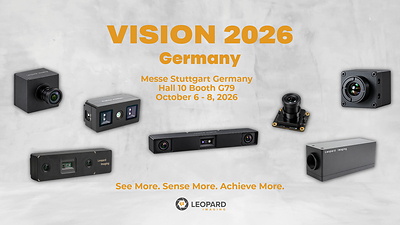
Visitors can meet the Leopard Imaging team at Hall 10, Booth 10G79, where the company will present a broad portfolio of live demonstrations for robotics, industrial automation, autonomous systems, machine vision, and edge AI applications.
Sirius Max with Lumotive LCM Technology – Long-Range 3D Perception
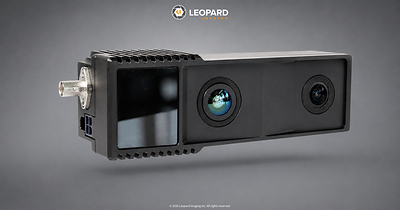
Sirius Max is a compact RGB + depth perception platform combining intelligent iToF depth sensing, programmable beam-steered illumination, and embedded synchronization. Designed for robotics and autonomous systems, the solution supports software-defined scanning and long-range 3D perception.
ASTRO Stereo Camera – High-Bandwidth RGB-IR Perception
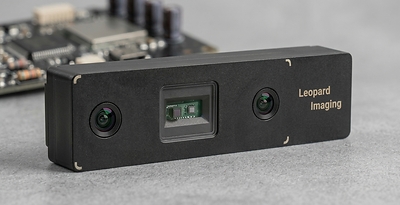
The ASTRO Stereo Camera integrates dual 5.1MP BSI global-shutter sensors, IR projection and illumination, and NVIDIA® Holoscan 10GigE connectivity. Demonstrated on the NVIDIA Jetson Thor platform, ASTRO supports synchronized RGB + IR stereo imaging, depth perception, 3D reconstruction, and AI perception pipelines.
IMX530 – High-Resolution Industrial AI Imaging
Built around the Sony 25MP IMX530 global-shutter sensor, this NVIDIA Holoscan 10GigE camera solution combines high-resolution imaging with FPGA processing for industrial inspection, barcode recognition, logistics automation, and other demanding machine vision applications.
Hybrid iToF RGB-D Camera – High-Precision Depth Sensing
The Hybrid iToF camera combines pulsed and phased indirect Time-of-Flight technologies with onsemi 1.2MP depth sensor. It is designed to provide high depth precision and reduced interference for robotics, 3D mapping, gesture recognition, and AR/VR applications.
IMX454 – Multispectral Imaging
The IMX454-based multispectral camera provides 41 spectral channels from 450 to 850 nm with 1948 × 1097 resolution at 30 FPS. The USB 3.0 UVC solution supports agriculture, food inspection, environmental monitoring, spectral analysis, and intelligent vision applications.
Dragonfly USB 3.0 YUV – 4K Camera with Integrated ISP
Dragonfly combines one onsemi 4K HyperLux LP sensor, integrated ISP, HDR imaging, and USB 3.0 connectivity. Its plug-and-play architecture is well suited for AI vision prototyping, smart kiosks, video conferencing, and industrial vision systems.
DragonFire – Real-Time Thermal Perception
DragonFire is an uncooled infrared camera delivering 640 × 512 resolution at 30/60 FPS with a 12 μm pixel size and NETD performance of ≤40 mK. Its GMSL2 interface supports robotics, industrial inspection, autonomous systems, and thermal monitoring applications.
Eagle 1 – RGB-IR Active Stereo Vision
Eagle 1 integrates two 5.1MP BSI global-shutter RGB-IR sensors, active IR illuminator, and a dot-pattern projector. The camera delivers RAW RGB and IR data for depth perception, intelligent navigation, robotics, and autonomous machines.
These demonstrations highlight our latest advances in AI perception. We welcome you to visit us to experience the technologies firsthand and meet our team.
About Leopard Imaging
Leopard Imaging is a global leader in AI perception and spatial intelligence solution design and manufacturing, delivering advanced imaging technologies for autonomous systems, robotics, AIoT, automotive, industrial automation, healthcare, and edge AI applications.
Media Contact
Leopard Imaging Marketing Team
Ariel Zhang
marketing@leopardimaging.com
 View original content to download multimedia:https://www.prnewswire.co.uk/news-releases/leopard-imaging-to-showcase-advanced-ai-perception-and-imaging-solutions-at-vision-2026-302891998.html




