Supreme Courts of Singapore and Korea Sign New Arrangements to Support Cross-Border Civil and Commercial Disputes
SEOUL, South Korea, Sept. 17, 2026 /PRNewswire/ -- The Supreme Court of Singapore and the Supreme Court of Korea signed two new instruments aimed at supporting the effective resolution of cross-border civil and commercial disputes on 16 September 2026.
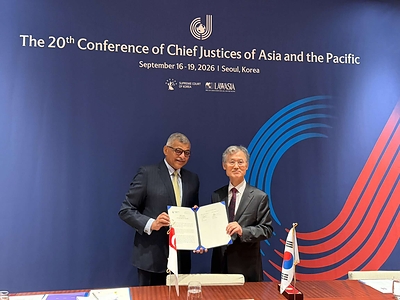
The Memorandum of Guidance as to the Enforcement of Money Judgments (MOG) and the Memorandum of Understanding on Cooperation Regarding Information on Foreign Law (MOU) were signed by The Honourable the Chief Justice Sundaresh Menon and Chief Justice Jo Hee-de of the Supreme Court of Korea. The signing took place in Seoul on the sidelines of the 20th Conference of Chief Justices of Asia and the Pacific, following a courtesy call between the two Chief Justices.
The MOG sets out the Singapore and Korean courts' understanding of the procedures and requirements for the recognition and enforcement of money judgments of one jurisdiction in the other. It covers judgments requiring payment of a sum of money and does not cover non-monetary relief or criminal orders, fines or penalties.
The MOG will serve as a practical reference for litigants and practitioners in cross-border cases by setting out the applicable legal requirements and procedures in both jurisdictions. This will provide greater clarity and understanding for parties seeking to a Singapore money judgment recognised and enforced in Korea, or a Korean money judgment recognised and enforced in Singapore.
Chief Justice Menon said: "A judgment may offer little real relief if it cannot be enforced where the judgment debtor or its assets are located. By explaining how our respective courts approach the recognition and enforcement of money judgments, the Memorandum will promote greater clarity, certainty and confidence for litigants."
The MOU establishes a mechanism for the Singapore and Korean courts to exchange information on their respective domestic laws and judicial practices in civil and commercial matters. It applies where a court is required to consider the law of the other jurisdiction in an ongoing international civil or commercial case.
Through the MOU, the Singapore and Korea courts will have a clearer and more efficient channel for obtaining reliable information on each other's laws and judicial practices in cross-border civil and commercial cases. Information exchanged may include relevant legislation, judicial precedents, decisions, interpretations and court orders. This will support the courts in determining questions of foreign law more accurately and efficiently.
For more details, visit News and speeches (judiciary.gov.sg)
 View original content to download multimedia:https://www.prnewswire.co.uk/news-releases/supreme-courts-of-singapore-and-korea-sign-new-arrangements-to-support-cross-border-civil-and-commercial-disputes-302881863.html




